The Landlord Database — what owners need to know

1. What the Private Rented Sector Database is…
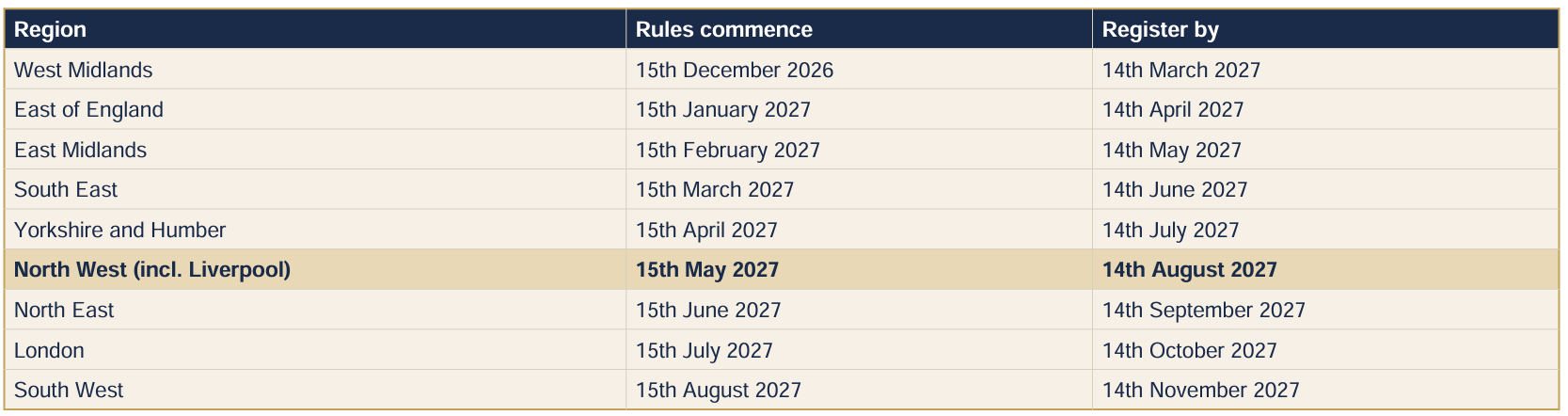
England’s new “Register your rental property” service is the Private Rented Sector (PRS) Database under the Renters’ Rights Act 2025. Landlords of assured or regulated tenancies must register themselves and each let property. Supported exempt accommodation under the Supported Housing (Regulatory Oversight) Act 2023 does not register on this service. The Ministry of Housing, Communities and Local Government (MHCLG) is rolling it out region by region from 15th December 2026 (West Midlands first). At this stage you only need to register properties that are currently let, or that become let during rollout.
2. North West dates
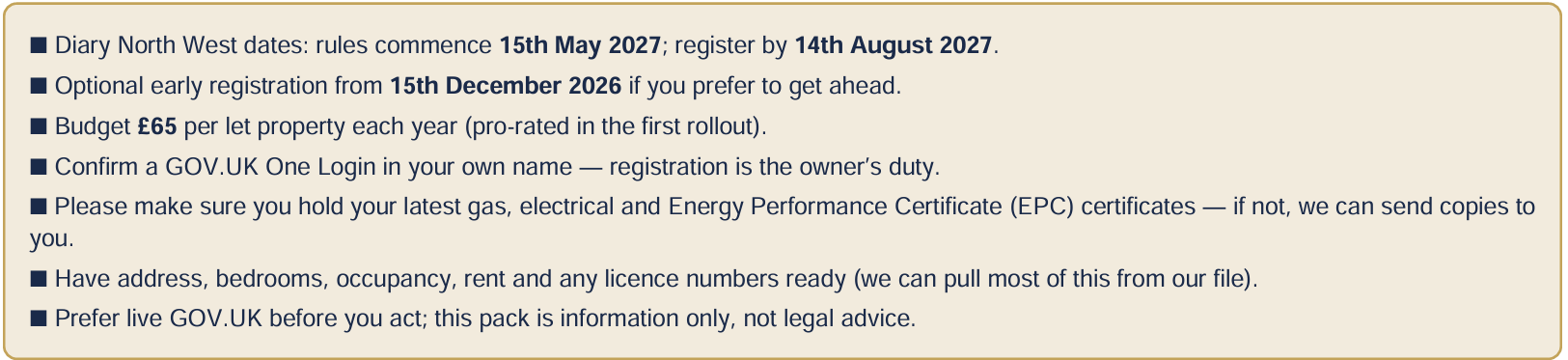
For Holmes&Co owners in the North West, rules commence on 15th May 2027, with a registration deadline of 14th August 2027. You can register earlier from 15th December 2026 if you prefer. After the deadline, councils in the region can begin enforcement. All actively letting landlords in England are expected to have registered by 14th November 2027.
3. What you will be asked for
You will need a GOV.UK One Login in your own name. Expect to provide landlord or company details; property address, type and bedrooms; occupancy and furniture; rent and frequency; licensing where it applies (House in Multiple Occupation (HMO), additional or selective licence); and health and safety documents — gas safety record (CP12) (if gas), Electrical Installation Condition Report (EICR) or Electrical Installation Certificate (EIC), and Energy Performance Certificate (EPC) where required. Please make sure you hold your latest gas, electrical and EPC certificates — if you do not have copies, Holmes can send them.
4. Fee, renewals and who can help
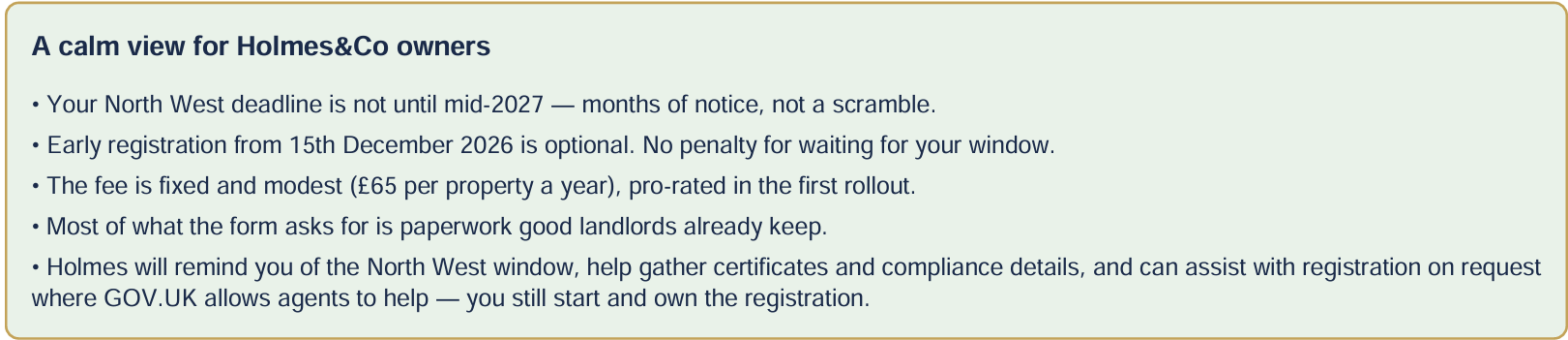
The annual fee is £65 per property. You pay when a dwelling entry is made or renewed, and renew every 12 months (entries that are not renewed become inactive). During the first rollout the fee is pro-rated so early adopters are not out of pocket. Landlords start registration themselves. A letting agent or property manager may upload certain information on your behalf once government agent guidance is live —
When future marketing rules for unoccupied homes go live, written adverts will need unique landlord and property identifiers. MHCLG will publish further guidance ahead of that requirement.
5. If you do not register — penalties and possession
Once your region’s three-month window has passed, a local housing authority may impose a civil penalty of up to £7,000 for failing to keep active landlord and dwelling entries (and related marketing or advertising duties when they apply). Knowingly or recklessly providing false or misleading information, or continuing certain breaches after a penalty, can attract a civil penalty of up to £40,000 or a criminal offence. While a landlord is in breach of the active-entry duty, a court may not make a possession order except on Ground 7A or Ground 14 (serious / anti-social behaviour). Rent repayment orders can follow for false database information and for certain continuing database breaches after a penalty.
6. Why not to worry — and how Holmes helps
A mandatory PRS Landlord Ombudsman is expected later in Phase 2 (government roadmap: around 2028). That is separate from this database briefing — we will write to you when membership becomes required.
7. Owner checklist
8. Sources
MHCLG Housing Hub — Get ready: ‘Register your rental property’ service (checked October 2026): https://housinghub.campaign.gov.uk/renting-is-changing/get-ready-to-register/
GOV.UK news — Stronger protections and greater confidence for renters (published 9th September 2026)
Draft SI — The Private Rented Sector Database Regulations 2026: https://www.legislation.gov.uk/ukdsi/2026/9780348286861/contents
Renters’ Rights Act 2025 sections 75, 82, 90–92 and 98 (penalties, possession restriction, rent repayment orders)
Implementation roadmap — PRS Landlord Ombudsman membership expected around 2028